
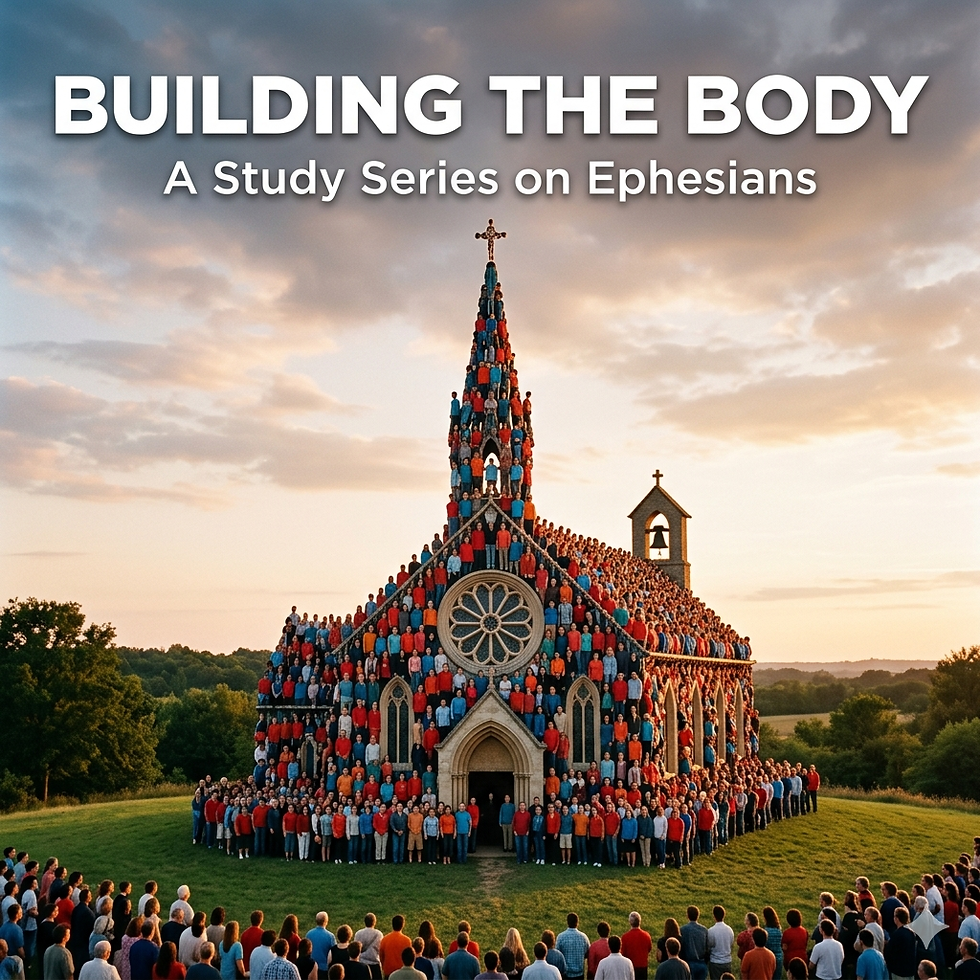
Building The Body Study 9 - Reconciliation in the Body
Ephesians 2:11-22 NIV
[11] Therefore, remember that formerly you who are Gentiles by birth and called “uncircumcised” by those who call themselves “the circumcision” (which is done in the body by human hands)— [12] remember that at that time you were separate from Christ, excluded from citizenship in Israel and foreigners to the covenants of the promise, without hope and without God in the world. [13] But now in Christ Jesus you who once were far away have been brought near by the blood of Christ. [14] For he himself is our peace, who has made the two groups one and has destroyed the barrier, the dividing wall of hostility, [15] by setting aside in his flesh the law with its commands and regulations. His purpose was to create in himself one new humanity out of the two, thus making peace, [16] and in one body to reconcile both of them to God through the cross, by which he put to death their hostility. [17] He came and preached peace to you who were far away and peace to those who were near. [18] For through him we both have access to the Father by one Spirit. [19] Consequently, you are no longer foreigners and strangers, but fellow citizens with God’s people and also members of his household, [20] built on the foundation of the apostles and prophets, with Christ Jesus himself as the chief cornerstone. [21] In him the whole building is joined together and rises to become a holy temple in the Lord. [22] And in him you too are being built together to become a dwelling in which God lives by his Spirit.
(Read the full passage at: https://bible.com/bible/111/eph.2.11-22.NIV)
We live in a divided world. But often if we view the causes of those divisions through a neutral, dispassionate viewpoint, they really are very petty.
In 1925, for example, a stray dog crossed the border from Greece into Bulgaria. This single, innocent act triggered a border clash that cost dozens of lives.
Whole wars have been triggered over, for example, the shooting of a pig or a football match or the right to sit on a golden stool.
We laugh and mock at such historical escapades, but the truth is that the church has become divided – and sometimes violently so – on much lesser subjects. I have been in churches that have been bitterly divided over Bible translations or the colour of paint on the walls or which hymn books to sing from.
Yes, really.
I have worked with churches who came from different denominations separated by the theological equivalent of a hair’s breadth, and yet who just could not work together.
Yes, it was very frustrating.
These verses serve as a stern rebuke to any who want to divide the church along denominational or sectarian lines. As we study them, I pray that the Word of God will indeed be a double-edged sword (Hebrews 4:12) that will slice away any bigoted, proud, divisive thoughts we may have, because – and I do not hesitate to say this – they are sinful and against the will of God for our lives.
Let’s start this study by reminding ourselves of the somewhat superheated context in which they took place by examining The Situation.
The Situation
John 4:9 NIV
[9] The Samaritan woman said to him, “You are a Jew and I am a Samaritan woman. How can you ask me for a drink?” (For Jews do not associate with Samaritans.)
(Read the full passage at: https://bible.com/bible/111/jhn.4.9.NIV)
Acts 11:1-3 NIV
[1] The apostles and the believers throughout Judea heard that the Gentiles also had received the word of God. [2] So when Peter went up to Jerusalem, the circumcised believers criticized him [3] and said, “You went into the house of uncircumcised men and ate with them.”
(Read the full passage at: https://bible.com/bible/111/act.11.1-3.NIV)
Ephesians 2:11-12 NIV
[11] Therefore, remember that formerly you who are Gentiles by birth and called “uncircumcised” by those who call themselves “the circumcision” (which is done in the body by human hands)— [12] remember that at that time you were separate from Christ, excluded from citizenship in Israel and foreigners to the covenants of the promise, without hope and without God in the world.
(Read the full passage at: https://bible.com/bible/111/eph.2.11-12.NIV)
I grew up during a very divided time in history. I was raised in the sectarian West of Scotland, not entirely separated from the Irish Troubles, during the Cold War, when Eastern and Western Europe were split apart by the Iron Curtain. South Africa was divided along racial lines.
As the Berlin Wall fell and Apartheid in South Africa ended and the Good Friday Agreement silenced the guns and bombs in Northern Ireland, there was hope that all that disunity and division would end and that we would all be one.
That hope has long since faced.
These days, nefarious people with evil intent divide us so that they can gain power and influence. Their ego trip and power madness become our riot-filled streets and our invective-laden social media sites.
Yet all these have nothing at all on the divisions between Jew and Gentile.
As with all divisions, this one was rooted in a sense of right and wrong. On the surface, the Jews were trying hard to maintain their ritual and religious purity. They wanted nothing to do with the wanton pagan idolatry of the nations around them. They certainly didn’t want to be corrupted by the idol shrines and images in Gentile homes. That’s why we see this little nugget, buried deep in the account of the crucifixion:
John 18:28 NIV
[28] Then the Jewish leaders took Jesus from Caiaphas to the palace of the Roman governor. By now it was early morning, and to avoid ceremonial uncleanness they did not enter the palace, because they wanted to be able to eat the Passover.
(Read the full passage at: https://bible.com/bible/111/jhn.18.28.NIV)
So yes, these Jewish leaders had no qualms about getting an innocent man killed, but are careful to avoid ritual impurity so they can eat the Passover.
The deep division between Jews and Gentiles even went as far as Jews dubbing the Gentiles as ‘dogs’ (Matthew 15:26-27 – a derogatory term as dogs were unclear for Jews – see Leviticus 11:27). So between Jews and Gentiles there was a barrier of religion.
There was also a barrier of nationalism. The Romans were occupying Jerusalem. History tells us that a deep sense of unease existed between the two groups. Almost two hundred years prior, the Seleucid Greek King Antiochus IV Epiphanes had worshipped Zeus in the Temple and sacrificed pigs on the altar, leading to a violent uprising against him by the Maccabees. Now, with the Jewish capital again under the boot of a Gentile power, we can only imagine how much that would have rankled.
If ever there was a division that would seem to be justified, if ever there was a difference we did not think could be healed, if ever there were two groups of people who we would think would never be able to mix, it would be Jews and Gentiles.
And yet...
And t we move on from the situation to see The Act that united them.
The Act
Ephesians 2:13 NIV
[13] But now in Christ Jesus you who once were far away have been brought near by the blood of Christ.
(Read the full passage at: https://bible.com/bible/111/eph.2.13.NIV)
The name Gordon Wilson might not mean very much to our current generation, particularly to those who are not Irish, but this man played a vital role in history that I lived through. He was not a great leader, politician or CEO. He was an ordinary man. But in 1987, when the Irish Republican Army bombed a Remembrance Day parade at Eniskillen, Northern Ireland, his daughter was seriously injured by the blast. He held her hand as she was dying in hospital and gave a famous TV interview there where he uttered the famous words that rebounded across the world: ‘I bear no ill will. I bear no grudge.’
This incredible man became a picture of reconciliation. He was willing to do what no politician on either side of the Irish Troubles was willing to do: he met with armed paramilitaries and persuaded them that peace was better than violence.
Determined men like him laid the ground work for the Good Friday Agreement, in which both sides laid down their arms.
The path to peace was lined with blood: his daughter‘s blood.
But Jesus got there first.
These words are striking and they are extraordinary. As we saw in the previous section, the Gentiles were far from God: despised by the Jews, uncircumcised and with no means at all of bridging the gap.
What brought them to God was Christ’s sacrifice on the cross. Their equal status with the Jews, their entry into the Body of Christ and their very salvation was blood-bought.
As we saw in the last study:
Ephesians 2:8-9 NIV
[8] For it is by grace you have been saved, through faith—and this is not from yourselves, it is the gift of God— [9] not by works, so that no one can boast.
(Read the full passage at: https://bible.com/bible/111/eph.2.8-9.NIV)
Salvation is by grace alone through faith alone in Christ alone. There is no other way. Heritage and lineage and paternity are all meaningless in this regard. They count for nothing.
Paul, with his impeccable Jewish pedigree, knew all about this:
Philippians 3:4-9 NIV
[4] If someone else thinks they have reasons to put confidence in the flesh, I have more: [5] circumcised on the eighth day, of the people of Israel, of the tribe of Benjamin, a Hebrew of Hebrews; in regard to the law, a Pharisee; [6] as for zeal, persecuting the church; as for righteousness based on the law, faultless. [7] But whatever were gains to me I now consider loss for the sake of Christ. [8] What is more, I consider everything a loss because of the surpassing worth of knowing Christ Jesus my Lord, for whose sake I have lost all things. I consider them garbage, that I may gain Christ [9] and be found in him, not having a righteousness of my own that comes from the law, but that which is through faith in Christ—the righteousness that comes from God on the basis of faith.
(Read the full passage at: https://bible.com/bible/111/php.3.4-9.NIV)
The logic of this is as simple as it is profound. The Gospel places us on an equal footing: all are lost; all are saved through Christ. All therefore were far from God, because all have sinned; all are in equal need for Christ to pay the price for their sin:
Romans 3:22-24 NIV
[22] This righteousness is given through faith in Jesus Christ to all who believe. There is no difference between Jew and Gentile, [23] for all have sinned and fall short of the glory of God, [24] and all are justified freely by his grace through the redemption that came by Christ Jesus.
(Read the full passage at: https://bible.com/bible/111/rom.3.22-24.NIV)
Salvation is the single greatest need for all of humanity. If none of us could achieve it or earn it or inherit it but we need to receive it as a free gift from Jesus Christ, then all grounds for boasting or feeling superior are blown apart.
We are all equal.
Christ’s sacrifice that unifies us tells us how much He values us and our relationship with Him, but also how much He values our relationships with other people. If He was willing to pay such an incredibly high price to unite us with other people, then dare we devalue or disregard or cheapen that relationship by treating it with contempt?
Christ’s sacrifice on the wasn’t just the act that brought about our reconciliation with each other, it was also The Means through which this reconciliation was brought about.
The Means
Ephesians 2:14-18 NIV
[14] For he himself is our peace, who has made the two groups one and has destroyed the barrier, the dividing wall of hostility, [15] by setting aside in his flesh the law with its commands and regulations. His purpose was to create in himself one new humanity out of the two, thus making peace, [16] and in one body to reconcile both of them to God through the cross, by which he put to death their hostility. [17] He came and preached peace to you who were far away and peace to those who were near. [18] For through him we both have access to the Father by one Spirit.
(Read the full passage at: https://bible.com/bible/111/eph.2.14-18.NIV)
As I explained earlier, for those of us who lived through it, November 9, 1989 was a truly emotional day. That was the day the Berlin Wall fell. I remember as a not very butch fourteen year old, watching it happen on the news and almost feeling like I could cry for joy.
That monstrosity was a sore on the face of Europe for decades. It stood for a barrier between two worlds: between communist Eastern Europe and the capitalist west. Many people, who had wanted nothing more than a better life, had died trying to cross that wall. Now that it was down, people would be united. Life would just be better. At least, that’s what the romantic optimists, and the cartoons (even Alvin and the Chipmunks) told us. It had to be true, hadn’t it?
Of course, it took many years for the unity between East and West Germany to be fully worked out. There are many in the East who are still quite unsatisfied with how things worked out.
But the point of my illustration is that there once was a barrier that divided a continent, and then it was gone.
There was also a barrier that divided the world. As Paul stated, there were laws that kept Gentiles – even Gentile converts to Judaism – away from the core of Temple worship.
Although it was not there in the design of the First Temple, the Herodian Temple featured a distinct courtyard where Gentiles could worship. Although that ‘could worship’ was largely theoretical, as by Jesus’ day the Jewish leadership had turned it into a veritable cattle market for sacrificial animals and Temple currency (Mark 11:15-19), such was their contempt towards even Gentile converts.
While the Law was non-discriminatory (Leviticus 19:33-34), there were certain nationalities that were banned from the assembly of the Lord’s people due to their historic misbehaviour (Deuteronomy 23:3-6). However, Mosaic law was reinterpreted and twisted as an excuse to keep all Gentiles at arm’s length.
But all this was blown apart by the cross. Centuries of tradition and norms were no longer relevant. Ancient laws were upended. Salvation by grace alone through faith alone in Christ alone means that both Jew and Gentile have equal access to the Father, and salvation, on the same basis and grounds. The same is true of all people everywhere. There is no difference.
This simple fact also destroys our attempts to set up spaces where some people are excluded from hearing the Word of God. If ancient Jewish laws and customs, established for centuries, could be ripped apart so we could hear the Gospel, what right to we have to exclude anyone?
I would have thought the answer was obvious:
None at all.
I want us to also notice something very important here. Paul links reconciliation with other people with a state of peace. Let me state this very plainly: we cannot enjoy the peace of God that passes all understanding and guards our hearts and minds (Philippians 4:7) while we are actively pursuing division and separation from other people. An ‘us versus them’ mentality will damage our peace and cause us to be in a state of turmoil.
It is not for nothing that the ancient Hebrew word for peace – shalom – refers not just to an absence of conflict but a presence of total well-being.
It is always in our best interests to seek reconciliation and unity with other Christians. Jesus died for it. Who are we to refuse it?
Apart from the situation, the act and the means, Paul also describes The Purpose: that is, why God wants His people to be reconciled and united.
The Purpose
Ephesians 2:19-22 NIV
[19] Consequently, you are no longer foreigners and strangers, but fellow citizens with God’s people and also members of his household, [20] built on the foundation of the apostles and prophets, with Christ Jesus himself as the chief cornerstone. [21] In him the whole building is joined together and rises to become a holy temple in the Lord. [22] And in him you too are being built together to become a dwelling in which God lives by his Spirit.
(Read the full passage at: https://bible.com/bible/111/eph.2.19-22.NIV)
The British countryside, particularly the estates, is sometimes littered with follies. These are building projects undertaken by people with more money than sense which were begun but not completed because the aristocrat who built them ran out of money.
We saw a spectacular example of this in Ha Long City, Vietnam, of all places. There are many so-called ‘ghost hotels’ there. They were built to entice visitors to its utterly spectacular bay to spend a night or two in the city.
But they were a catastrophic miscalculation. There is no airport in Ha Long. Most tourists stay in Hanoi and travel down on bus tours directly to their ships in Ha Long Bay. They have no desire to hang around.
As a result, multi-million dollar hotel and residence developments now lie completely empty.
It has to be said that the same thing is happening with many churches. They have forgotten their purpose. They are emptying. People are leaving. They have no reason to stay. Then they become apartments or shops or nightclubs, or even mosques or temples.
The decline sets in when they forget their purpose and are diverted to become anything else.
When we have been travelling around Europe we have entered into several churches that have become historical monuments, where there are more tourists than parishioners, more cameras than candles, more historical guides for sale than Bibles being handed out. The focus has stopped being God and has become the building.
Right here, in these verses, we see the point of all the sacrifice and the pain and the reconciliation. We see what God wants His church to truly be.
We see that He wants it to be a union of strangers: a group of people who should not be together, but are. Look again at 1 Corinthians 12. While many in this world are seeking uniformity – where everyone thinks and feels and acts exactly the same – Paul preached unity in diversity. He preached that the church was united with God as its Head, but every part of it was different and each had a different part to play.
If we were all identical and lived in a monoculture where nothing was ever different, there would be no glory for God in that. It’s easy to unite people like that.
But when strangers who are all very different people – different skills, different abilities, different backgrounds, different sensitivities – are blended together and live a life of love, that is when the world stands up and takes notice and God gets the glory.
We also see that it should be built on the apostles and prophets. Paul explained the same concept elsewhere:
1 Corinthians 3:10-11 NIV
[10] By the grace God has given me, I laid a foundation as a wise builder, and someone else is building on it. But each one should build with care. [11] For no one can lay any foundation other than the one already laid, which is Jesus Christ.
(Read the full passage at: https://bible.com/bible/111/1co.3.10-11.NIV)
The point is that any real church is built on the foundation of obeying the Word of God, as Jesus Christ taught it to the apostles (Matthew 7:24-27). If we undermine that foundation, we are undermining ourselves. When the doubt and disobedience termites bring our church building to the ground with a great crash, we will have no-one to blame but ourselves for allowing them to attack the foundations.
Thirdly we see that it has Jesus as the cornerstone.
The cornerstone in any ancient building was the most important part. It was the first stone to be laid. All other stones were measured from it. The two main load-bearing walls met at it.
Without it, the building would collapse.
The same is absolutely true of Jesus. We see this elsewhere in Scripture:
Isaiah 28:16 NIV
[16] So this is what the Sovereign Lord says: “See, I lay a stone in Zion, a tested stone, a precious cornerstone for a sure foundation; the one who relies on it will never be stricken with panic.
(Read the full passage at: https://bible.com/bible/111/isa.28.16.NIV)
This prophecy is about Jesus.
So if a church has Jesus as its cornerstone, He comes first. All ministries are about Him and lead back to Him. They are governed by His standards and guided by His teaching. Nothing else is more important. Nothing else compromises it.
Churches built like this are built to last.
Churches built around anything else – be it tradition, history or cultural relevance – are bound to fail.
Fourthly, we see that a true church is a temple of the Holy Spirit. That is, the gathering of the people in the church is where people come to meet with God.
As Jesus told the disciples:
Matthew 18:20 NIV
[20] For where two or three gather in my name, there am I with them.”
(Read the full passage at: https://bible.com/bible/111/mat.18.20.NIV)
This, again, is a critical concept. The Presence of God was an important part of Jewish identity that signified they were different from other races (Exodus 33:12-17). When God’s Presence filled the Temple, that was God’s sign that the project had His blessing (2 Chronicles 5:13-14). Jesus’ Presence in the Upper Room was one of the most important appearances that proved the Resurrection (John 20:19-23). The church came into existence because of a manifestation of this Presence (Acts 2:1-11).
Here we see Paul using Temple language to refer to the church being built into a Temple where God is worshipped.
Think about this for a second: do jewellers sell their precious wares in egg boxes? No, they usually use velvet-lined boxes to show then off. The contents of the box make the box much more valuable.
In the same way, God’s Presence makes the church valuable. God’s Presence makes it worth something.
If God deigns to grace the church with His Presence, then who are we to say that it’s worthless?
And here’s the thing: this passage also tells us that we are a vessel for the Presence of the Holy Spirit. The church therefore becomes a bit like a Russian Babushka doll. The church is the place where we become more aware of the Presence of God, but the Presence of God is also in us.
That has enormous implications for how we live our lives, as Paul explained elsewhere:
1 Corinthians 6:18-20 NIV
[18] Flee from sexual immorality. All other sins a person commits are outside the body, but whoever sins sexually, sins against their own body. [19] Do you not know that your bodies are temples of the Holy Spirit, who is in you, whom you have received from God? You are not your own; [20] you were bought at a price. Therefore honor God with your bodies.
(Read the full passage at: https://bible.com/bible/111/1co.6.18-20.NIV)
The Presence of God in our lives makes them special and valuable. For that reason, we should not treat them with contempt. That includes using our bodies to indulge in sexual immorality or other immoral acts.
Do you see the link?
Before someone decides to build a building, they must first have a purpose. They must understand why they are building it. God had a clear purpose in building the church: to bring glory to Himself through worship and through righteous living. The church has not always understood this. It certainly has not always lived up to it.
But regardless, this is God’s purpose.
Dare we question it or oppose it?
Should we not just submit to it?
Conclusion
Ephesians 2:19-20 NIV
[19] Consequently, you are no longer foreigners and strangers, but fellow citizens with God’s people and also members of his household, [20] built on the foundation of the apostles and prophets, with Christ Jesus himself as the chief cornerstone.
(Read the full passage at: https://bible.com/bible/111/eph.2.19-20.NIV)
On the outside, the Filipino village of Moalboal isn’t that much to look at. It doesn’t seem to be so special. Sure, there were hotels and guest houses, restaurants and cafes, souvenir shops and take-away food places. But the village itself is quite ordinary.
What happens a short distance away off the coast of Panagsama Beach is far from ordinary.
Within a remarkably short swim from the shoreline, between three and five million sardines are believed to live. When many thousands of them are visible, the sight is quite simply one of the outstanding natural phenomena in the world.
This small village has a truly incredible natural attraction.
The church has long been derided by those who don’t truly understand its purpose. To be fair, sometimes neither has the church. It has long gotten involved with things it should not and allowed itself to become implicated in murky politics, grubby finances and some incredibly distasteful immoral behaviour.
None of these are what the church is for. As I described earlier, comparing such churches to the true church is like comparing a scrunched up drinks can with a football.
They are just not the same thing.
Here we see the simple truth that the church’s mission has to involve reconciliation because reconciliation is a very important by-product of the Gospel. In fact, it is impossible to truly believe in the Gospel and not be reconciled to someone of whom you have made an enemy.
We’ve seen how there was a huge divide in Paul’s day between Jew and Gentile, and how many would have sought to justify and support this division. We saw, in fact, that it was the most reasoned division there has ever been in history, yet Christ breached it.
The act that breached that division was the cross itself. This shows us how much Christ values unity and reconciliation: He died for it.
We saw the means of reconciliation: how the same grace shown to Jew and Gentile demolished the rules that kept them apart.
We saw the purpose of this reconciliation, which was to unite both into a church that would glorify God and where He would be worshipped.
I want you to imagine a choir. That choir is not as organised as most. It’s singers are constantly arguing over who should sing what parts and who should get the solos. Even when not arguing, they constantly try to sing over each other.
Will such a choir be able to sing in tune?
Yes, but they need to put their differences behind them.
In the same way, it isn’t possible for us to truly worship God until we have submitted to His work of reconciliation and solved our issues with each other. That is why Jesus gave this command:
Matthew 5:23-24 NIV
[23] “Therefore, if you are offering your gift at the altar and there remember that your brother or sister has something against you, [24] leave your gift there in front of the altar. First go and be reconciled to them; then come and offer your gift.
(Read the full passage at: https://bible.com/bible/111/mat.5.23-24.NIV)
The value of something is the price someone is willing to pay for it. These verses tell us that Jesus gave His life so His church would be united. He paid the price for our sins and theirs.
Dare we tell Jesus it’s not enough?
Jesus even prayed for unity in His last hours on earth (John 17:20-23).
The call of the Gospel includes being reconciled to our neighbour. If we resist it, we have not properly understood the Gospel at all.
So tell me: is it time you sought reconciliation?
Prayer
Lord Jesus, I see now the importance You place on reconciliation and unity on the Body of Christ. I confess that sometimes I have not placed the same value on it, and have instead been antagonistic and desperate to get my own way. Forgive me, I pray. Help me instead to seek to strengthen my relationships with other people, particularly in the church. Amen.
Questions for Contemplation
How do we know that reconciliation is important to Jesus? What is it that proves this?
What effect did this reconciliation have on strained relationships in Jesus’ day?
Is there anyone with whom you should seek reconciliation? How will you do it?
Comments