
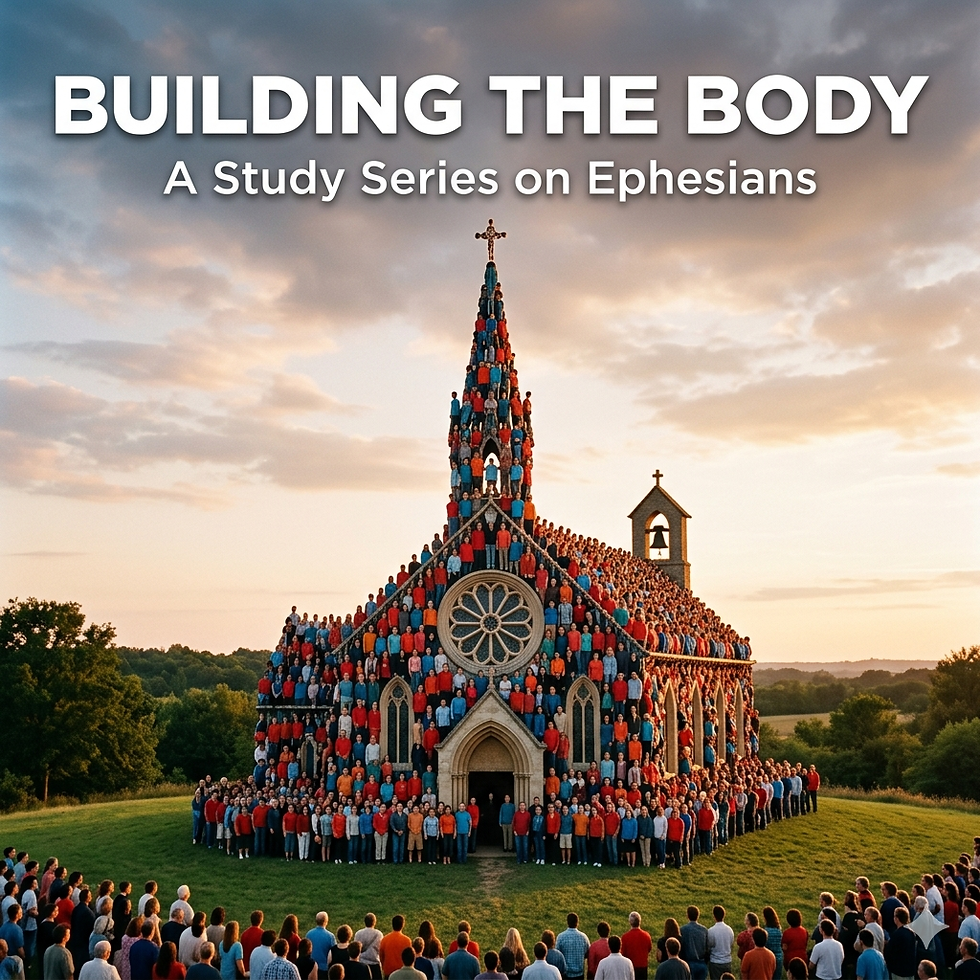
Building The Body Study 1 - Purpose of the Body
Ephesians 4:11-13 NIV
[11] So Christ himself gave the apostles, the prophets, the evangelists, the pastors and teachers, [12] to equip his people for works of service, so that the body of Christ may be built up [13] until we all reach unity in the faith and in the knowledge of the Son of God and become mature, attaining to the whole measure of the fullness of Christ.
(Read the full passage at: https://bible.com/bible/111/eph.4.11-13.NIV)
Which entity do you know can meet in grand buildings and small rooms in houses, can use spectacular music and art but can also meet in plain rooms, can sing and dance and make a huge noise but can also be more silent than a whisper, can be youthful and energetic but also old and wise, can cross the world with its message but also cross the street to care for the needy?
I am talking, of course, about the Christian church.
I have seen many and varied expressions of the church.
I have been in Romanian churches that sing country and western songs.
I have been in Czech Brethren churches that were so quiet even their singing was almost on mute.
I have sung to backing tracks, keyboards that could only play rock and roll because the rhythm key got stuck and spectacular bands, orchestras and choirs.
I have met fellow believers in converted houses, school gymnasiums and, perhaps, by the time this study is published, a ballroom in a casino hotel.
I have danced, pogo-ed, raised my hands, clapped, performed action songs and sat in absolute silence. I have sung (or, rather, attempted to sing) in English, Romanian, Czech, Tagalog, Cebuano, and possibly, if I remember correctly, in Swahili, as well as hearing choirs sing in English, Latin, Romanian, French and Italian.
I have been in immigrant churches were many of the congregation were breaking their visa conditions and churches where I was the only foreigner. I have used hymnals, chorus books, song sheets, overhead projector sheets and video projectors.
Yet every single one of these, without exception, was just as valid an expression of what it means to be a church as any other.
How can a gathering of people be so very different yet still the same?
That is because God has created His Body to be so wonderfully diverse. 1 Corinthians 12:7-31 explains this perfectly. When we enter a church, we are not entering a fast food restaurant or a coffee shop. We should not expect every church to be exactly the same. They are made up of different people, so they will be all different. There is nothing wrong with that.
Neither should we expect everyone in them to be the same. They will all be different. There is nothing wrong with that either.
But there are some things we should expect from a church, wherever they are and however they worship. We will explore these in this series.
We will start by exploring what the church is, where it comes from and where it is going. In this series, we will use the church at Ephesus for our entry point.
We will do it for several reasons. Firstly, because Paul lived there for a while and used it as a missionary base.
Secondly, because this church in a busy multicultural metropolis reflects the situation of many churches across the globe.
Thirdly, because the history of this church and Paul’s teaching in his letter are very helpful as we examine the church and our part in it.
We’ll start by looking at some key verses to help us understand what Paul teaches about the church:
Ephesians 4:11-13 NIV
[11] So Christ himself gave the apostles, the prophets, the evangelists, the pastors and teachers, [12] to equip his people for works of service, so that the body of Christ may be built up [13] until we all reach unity in the faith and in the knowledge of the Son of God and become mature, attaining to the whole measure of the fullness of Christ.
(Read the full passage at: https://bible.com/bible/111/eph.4.11-13.NIV)
Let’s begin, then, by looking at He Who Gave.
He Who Gave
Ephesians 4:11 NIV
[11] So Christ himself gave...
(Read the full passage at: https://bible.com/bible/111/eph.4.11.NIV)
When I was a missionary, I sometimes received letters from home. These always had to be addressed with the sender’s details as well as my own. This was useful if the letter ever had to be returned.
Nowadays, as we have drifted away from paper communications to email, text messages and instant messaging, every message we send has the sender’s details on it.
These verses are no different. And for good reason.
Allow me to explain.
There is a wrong understanding out there in the secular world. The belief persists that the church was ‘man-made’: that human beings came up with the idea and built the church.
Churches have often not helped relieve them of this misapprehension because they have named their buildings after people who started them as a memorial to them.
The Bible does not teach this. The Bible teaches that the church, and all its many expressions, are God-initiated, God-ordained, God-commissioned and God-made.
They also believe that human beings lead the church. Again, we don’t help ourselves with this. Our ceremonial leaders often love the limelight and give the distinct impression that they are in charge.
Nothing could be further from the truth. Take a look at these verses from Colossians:
Colossians 1:15-18 NIV
[15] The Son is the image of the invisible God, the firstborn over all creation. [16] For in him all things were created: things in heaven and on earth, visible and invisible, whether thrones or powers or rulers or authorities; all things have been created through him and for him. [17] He is before all things, and in him all things hold together. [18] And he is the head of the body, the church; he is the beginning and the firstborn from among the dead, so that in everything he might have the supremacy.
(Read the full passage at: https://bible.com/bible/111/col.1.15-18.NIV)
No church leader can claim that.
Look again at what Jesus said to Peter:
Matthew 16:18 NIV
[18] And I tell you that you are Peter, and on this rock I will build my church, and the gates of Hades will not overcome it.
(Read the full passage at: https://bible.com/bible/111/mat.16.18.NIV)
Who will build whose church? Jesus will build His church.
So right away, we must be done with the notion that it is our church: that we created it and we must lead it.
Balderdash!
It’s God’s church. Not ours. What He does with it is His affair, not ours.
But there is something very interesting about those verses in Ephesians, and that is the verses that came before:
Ephesians 4:7-10 NIV
[7] But to each one of us grace has been given as Christ apportioned it. [8] This is why it says: “When he ascended on high, he took many captives and gave gifts to his people.” [9] (What does “he ascended” mean except that he also descended to the lower, earthly regions? [10] He who descended is the very one who ascended higher than all the heavens, in order to fill the whole universe.)
(Read the full passage at: https://bible.com/bible/111/eph.4.7-10.NIV)
What Paul is doing here is quoting from an ancient translation of Psalm 68:18. The original flips it round: the conquering king receives gifts from men. However, better scholars than me have indicated that the Hebrew of Psalm 68:18 allows for the conquering king to be giving gifts to men.
Either way, what we have here is a king returning to Jerusalem after a great victory and the celebrations that ensue. Psalm 68:17 indicated that the king would be ascending to the Temple; Paul’s application is that He was ascending to the Temple not built by human hands in Heaven (Hebrews 9:11).
The point being that the church exists because Jesus has triumphed over death and hell.
Now, that puts a very different spin on the church’s existence. Many of us might be under the misapprehension that the church exists to bring about Christ’s victory. There are even branches of it that are dubbed His ‘Army’.
But that just is not true. The church itself is a symbol of Christ’s final and absolute victory. It exists and is resourced because Jesus Christ died, has beaten death and has ascended to Heaven. The church is not and never has been the garrisons through which this victory is enacted.
Far from it.
Churches are instead the embassies and outposts through which the terms of surrender are accepted.
The victory has already been won. It is Christ’s and not the church’s. That is why the church exists.
And we must remember that.
I have been in so many churches, particularly smaller ones, that seem to have a cornered mentality. They feel like they are up against it. They seem to be battling to stay afloat. They struggle to maintain their services and traditions against modernity because that’s all they have and if they lose it then everything is lost.
That is a completely wrong mentality. The Bible is clear:
Romans 8:37 NIV
[37] No, in all these things we are more than conquerors through him who loved us.
(Read the full passage at: https://bible.com/bible/111/rom.8.37.NIV)
Of course, we cannot be proud or triumphalist about this because the victory is not ours – it is Christ’s. We are merely the humble beneficiaries of Someone Else’s victory.
But at the same time, we are on the victory’s side. We have won. We are more than conquerors. Hallelujah!
And this must affect how we approach our church life and our mission work. We should no longer cling to what we have out of nothing more than sheer desperation to hold on to a tradition or a way of life. These things are not what gave us our victory – Jesus Christ did it on the cross.
Instead, we should cling on to Jesus Christ as if our lives depended on it, let our ways of doing things adjust so His Kingdom is extended in our culture and realise that no matter what happens, we win through Jesus.
Many of us are well aware of the blockbuster film Titanic. When the ship went down, only those with upper class tickets had seats on the lifeboats. Those in lower classes were left to drown. Many clung to passing pieces of the ship and flotsam and jetsam to provide.
Jesus Christ is our lifeboat. Our traditions and our ways of doing things are often like clinging to a lead weight in the ocean and expecting to float.
Let’s realise that Jesus Christ has won the victory, give Him the glory He fully deserves and be prepared to let go of lesser things so that we can cling to Him.
Apart from He Who Gave – which reminds us of the primacy and Lordship of Jesus Christ above and beyond all others, we also see What He Gave.
What He Gave
Ephesians 4:11-12 NIV
[11] So Christ himself gave the apostles, the prophets, the evangelists, the pastors and teachers, [12] to equip his people for works of service, so that the body of Christ may be built up
(Read the full passage at: https://bible.com/bible/111/eph.4.11-12.NIV)
Gift-giving can be a minefield. We try to be thoughtful. We try to notice things. We try to get it right. But often we are just wrong – not because we don’t know a person, but because tastes change.
One of my uncles thought he really had got it right. He’d bought one of my sisters a prized ticket to see her favourite band in concert. They were American. We live in Scotland. The chances to see them were very rare. It seemed like the perfect gift to him.
There was just one problem: teenage girls are notoriously fickle. By the time the concert came around, she had already stopped listening to that band.
As part of His triumphal ascension from the grave, like a returning conqueror (see 1 Chronicles 16:1-3 to read about David doing something similar as the Ark of the Lord ascended to Jerusalem), Jesus distributed gifts. This time it wasn’t food or clothing or even money.
No, it was something far more valuable.
It was abilities. Callings. Vocations.
It was spiritual gifts.
Now, it’s here that things get really interesting.
Note firstly that these are God-given gifts. If you have one, then good for you! But it’s nothing to boast about. It’s not that you got it because you are special. You didn’t deserve it. You didn’t pay for it. You didn’t earn it. Your gift us a free gift from God. It doesn’t elevate you one bit above everyone else.
It came from God, not you. Therefore God should get the glory, not you.
Secondly, these are Word-centred gifts.
Look at the list of gifts Paul spoke about in 1 Corinthians 12:
1 Corinthians 12:7-11, 27-30 NIV
[7] Now to each one the manifestation of the Spirit is given for the common good. [8] To one there is given through the Spirit a message of wisdom, to another a message of knowledge by means of the same Spirit, [9] to another faith by the same Spirit, to another gifts of healing by that one Spirit, [10] to another miraculous powers, to another prophecy, to another distinguishing between spirits, to another speaking in different kinds of tongues, and to still another the interpretation of tongues. [11] All these are the work of one and the same Spirit, and he distributes them to each one, just as he determines.
[27] Now you are the body of Christ, and each one of you is a part of it. [28] And God has placed in the church first of all apostles, second prophets, third teachers, then miracles, then gifts of healing, of helping, of guidance, and of different kinds of tongues. [29] Are all apostles? Are all prophets? Are all teachers? Do all work miracles? [30] Do all have gifts of healing? Do all speak in tongues? Do all interpret?
(Read the full passage at: https://bible.com/bible/111/1co.12.7-30.NIV)
And again, to the Romans:
Romans 12:3-8 NIV
[3] For by the grace given me I say to every one of you: Do not think of yourself more highly than you ought, but rather think of yourself with sober judgment, in accordance with the faith God has distributed to each of you. [4] For just as each of us has one body with many members, and these members do not all have the same function, [5] so in Christ we, though many, form one body, and each member belongs to all the others. [6] We have different gifts, according to the grace given to each of us. If your gift is prophesying, then prophesy in accordance with your faith; [7] if it is serving, then serve; if it is teaching, then teach; [8] if it is to encourage, then give encouragement; if it is giving, then give generously; if it is to lead, do it diligently; if it is to show mercy, do it cheerfully.
(Read the full passage at: https://bible.com/bible/111/rom.12.3-8.NIV)
Now, I believe that none of these lists are exclusive. I believe there are other gifts – such as poet or songwriter or coder or producer or sound-mixer or pretty much anything else – that didn’t make these lists and are equally as needed, and acceptable – within the church.
But in Ephesians 4, the focus is one particular type of gift: Bible communication.
These are gifts that are primarily focused on reaching and preaching and teaching people the Word of God.
Paul was communicating something clearly here. We saw earlier how a good church teaches the primacy of the Son of God – that He is the only God who is victorious over sin and death and hell. Now we see the importance of the primacy of the Word of God – that it is taught and communicated accurately and faithfully.
That is not to say that it is more important than other gifts. If even the apostles considered themselves as servants of the church (2 Corinthians 4:5), then how much more our teachers and preachers? Placing them in sole charge of the church is like placing the chef in charge of the hotel. Our teachers and preachers serve us by serving up spiritual food. They are our spiritual cooks and waiters. Their service is no less vital than those who clean the church or who lead Sunday school classes or work the technology behind the scenes.
We all carry out a vital function in the Body of Christ (1 Corinthians 12:12-26).
But in these verses Paul is highlighting the vital contribution that preachers and teachers make to helping us grow in Christ. The reason that their ministry is so important is not because they are so important, but because the Word of God is so important.
I don’t known if you have ever had the experience of seeing a loved one on a hospital bed, hooked up to a drip through which medications are administered from a bag hanging from a tube above them. Preachers and teachers are like the bag, or the tube or the cannula through which the medication passes; the Word of God is the medication.
It is not the preachers or the teachers who change lives, it is the Word of God that makes the difference:
Psalms 119:9 NIV
[9] How can a young person stay on the path of purity? By living according to your word.
(Read the full passage at: https://bible.com/bible/111/psa.119.9.NIV)
Psalms 119:105 NIV
[105] Your word is a lamp for my feet, a light on my path.
(Read the full passage at: https://bible.com/bible/111/psa.119.105.NIV)
Hebrews 4:12 NIV
[12] For the word of God is alive and active. Sharper than any double-edged sword, it penetrates even to dividing soul and spirit, joints and marrow; it judges the thoughts and attitudes of the heart.
(Read the full passage at: https://bible.com/bible/111/heb.4.12.NIV)
And so the elders, the teachers, the evangelists and the preachers set the tone for any church. Yes, we should seek to honour them and obey their teaching.
But we should also hold them account to ensure they practice what they preach:
Hebrews 13:7 NIV
[7] Remember your leaders, who spoke the word of God to you. Consider the outcome of their way of life and imitate their faith.
(Read the full passage at: https://bible.com/bible/111/heb.13.7.NIV)
Any church that prioritises the word of a human being – any human being at all – over the Word of God is not a true church.
Any church that prioritises anything over the Word of God is not a true church.
But any church that prioritises teaching and obeying the Word of God is the real thing. That is a church we really ought to join.
So we have seen He Who Gave, and how this teaches us the importance of the primacy of the Son of God. We have also seen What He Gave, and how the spiritual gifts Paul highlighted speak of the primacy of the Word of God.
We now look at Why He Gave.
Why He Gave
Ephesians 4:11-15 NIV
[11] So Christ himself gave the apostles, the prophets, the evangelists, the pastors and teachers, [12] to equip his people for works of service, so that the body of Christ may be built up [13] until we all reach unity in the faith and in the knowledge of the Son of God and become mature, attaining to the whole measure of the fullness of Christ. [14] Then we will no longer be infants, tossed back and forth by the waves, and blown here and there by every wind of teaching and by the cunning and craftiness of people in their deceitful scheming. [15] Instead, speaking the truth in love, we will grow to become in every respect the mature body of him who is the head, that is, Christ.
(Read the full passage at: https://bible.com/bible/111/eph.4.11-15.NIV)
A number of years ago, there was a ‘Secret Santa’ at my work. I was asked to organise it.
Now, I was sick fed up of bad, thoughtless gifts. If I was spending some of my hard-earned cash on this Christmas tradition, I wanted to get something good out of it and not feel like I had been ripped off. So I came up with an idea. A budget of £10 was set. Each participant was to submit a list of three things that they wanted within this budget and where the gift could be bought The list would be sent to whoever drew their name out of a hat. The person who drew them would then buy one of those gifts on the list.
It was a sure fire way to avoid disappointment.
Now, I have to admit to being a little canny with my gifts. One of my gifts was a Christian book that could only be bought from a nearby Christian bookstore, just because I wanted to see one of my non-Christian colleagues go into a Christian bookstore.
But one of my gifts – the one I received – caused consternation among some of my colleagues.
It was a surge protected power bar with four sockets.
‘That’s not a gift! Why did you ask for that?’ they questioned me.
But my answer was very simple. We were planning to visit our family in the Philippines the following month. Our visit would involve a layover in both directions in Asian hotels. We had a lot of devices (phones, cameras and the like). They had batteries that needed to be charged. As anyone who has been there will tell you, rural Philippines doesn’t always have a steady power supply. Surge protecting our devices would protect them from damage.
It was a very practical gift with a clear purpose.
There are many gifted Christians who do not understand the true purpose of their gifts.
They surrender to the modern culture of celebrity. They build themselves a power base. They become conceited and demanding. They sign autographs. They advertise their events with huge pictures of themselves. They refuse to mix or even speak with ‘the little people’. They become exaggerated caricatures of what a Christian should be.
They bring the Gospel no credit.
That is not why God gave us our gifts.
Paul explained to the Corinthians why they had been gifted from God:
1 Corinthians 14:12 NIV
[12] Since you are eager for gifts of the Spirit, try to excel in those that build up the church.
(Read the full passage at: https://bible.com/bible/111/1co.14.12.NIV)
We are called to build God’s Kingdom, not ours (Matthew 6:33). If we use our gifts to build our kingdom then we are abusing them.
So why precisely were these gifts given?
Paul told us: to grow and mature the church.
He even gave us three marks of a growing and mature church: service, solidarity and stability.
Firstly, service.
Take a good look at these verses again. What is the job of a Bible teacher? Is it to do all the work in a church?
No. It is to prepare God’s people – the church – for works of service.
This is something Paul discusses earlier in Ephesians as a key mark of those who are saved:
Ephesians 2:10 NIV
[10] For we are God’s handiwork, created in Christ Jesus to do good works, which God prepared in advance for us to do.
(Read the full passage at: https://bible.com/bible/111/eph.2.10.NIV)
So God gives us the motive, means and opportunity to do good works; the Bible teacher’s job is to prepare us to do them – to give us the ‘know-how’, to provide us with the boundaries and the limits, to give us the knowledge and awareness to fix our motivation and to give us the reasons why we should do them.
Now isn’t that interesting?
For centuries a church model has existed where a small number of salaried, full-time staff do most or all of the work in a church and the congregation are essentially spectators. We see it in many national and traditional churches.
It isn’t Biblical. Or at all Christian. Not one bit.
The church is the Body of Christ. If only a small percentage of your body worked then you would be thought of as very sick. Likewise a church is very sick if most of the people who come on a Sunday don’t contribute at all to the work of the church.
1 Corinthians 12:27 NIV
[27] Now you are the body of Christ, and each one of you is a part of it.
(Read the full passage at: https://bible.com/bible/111/1co.12.27.NIV)
Each one of us must contribute in some way to the work of the church. The purpose of the Bible teaching we receive is not so that we will feel encouraged or challenged or filled up with intellectual head knowledge, but so we will put it to work in and for the church.
Anything less is not a functioning church. Not a well functioning church at least.
Secondly, solidarity. Or, as we could call it, unity.
Ephesians 4:13 NIV
[13] until we all reach unity in the faith and in the knowledge of the Son of God and become mature, attaining to the whole measure of the fullness of Christ.
(Read the full passage at: https://bible.com/bible/111/eph.4.13.NIV)
Unity is a key sign of maturity.
Think about it: little children often fall out over the most pathetic things. Sometimes you wonder why they have fallen out over something so miniscule and ridiculous.
Now think about how believers relate.
Unfortunately the church also has a history of falling out over small issues that don’t matter, many of them pitiful and pathetic. I have worked in teams and between churches where the gap between Christian denominations was so small you could barely fit a sheet of paper between them, yet they would barely talk to each other.
If you see a church like that, particularly one riven by divisions within itself, steer clear. That is a clear sign that they are immature in their faith. They are more concentrated on winning arguments than winning souls. They are more bothered about building their own kingdoms (or rather, fiefdoms) than the Lord’s.
They are not following Jesus. It’s that simple.
Now, you might wonder how I can say something so sharp. It’s really simple: we are commanded to love each other.
John 13:34-35 NIV
[34] “A new command I give you: Love one another. As I have loved you, so you must love one another. [35] By this everyone will know that you are my disciples, if you love one another.”
(Read the full passage at: https://bible.com/bible/111/jhn.13.34-35.NIV)
The moment we love our own ego more than we love each other – or even God – then we have ceased to follow Jesus Christ and have tendered our resignation as His disciples.
Whatever the cause, and however justified it may seem, you do not need to be in a divided church, or even a divisive church. Not for your own spiritual health.
Thirdly, stability.
Ephesians 4:14-16 NIV
[14] Then we will no longer be infants, tossed back and forth by the waves, and blown here and there by every wind of teaching and by the cunning and craftiness of people in their deceitful scheming. [15] Instead, speaking the truth in love, we will grow to become in every respect the mature body of him who is the head, that is, Christ. [16] From him the whole body, joined and held together by every supporting ligament, grows and builds itself up in love, as each part does its work.
(Read the full passage at: https://bible.com/bible/111/eph.4.14-16.NIV)
Note the link here. It cannot be missed.
Mature Christians are stable Christians. They have renewed minds that do not cave in to the vagaries and duplicities and hypocrisies and idiosyncrasies and capriciousness of culture:
Romans 12:1-2 MSG
[1-2] So here’s what I want you to do, God helping you: Take your everyday, ordinary life—your sleeping, eating, going-to-work, and walking-around life—and place it before God as an offering. Embracing what God does for you is the best thing you can do for him. Don’t become so well-adjusted to your culture that you fit into it without even thinking. Instead, fix your attention on God. You’ll be changed from the inside out. Readily recognize what he wants from you, and quickly respond to it. Unlike the culture around you, always dragging you down to its level of immaturity, God brings the best out of you, develops well-formed maturity in you.
(Read the full passage at: https://bible.com/bible/97/rom.12.1-2.MSG)
Mature Christians have done exactly that. They are not flotsam and jetsam, bobbing about on the currents and tides of culture, hoping somehow they will reach the shore.
Instead, they are anchored firmly in the supremacy of the Son of God and the Word of God. They are unyielding in their absolute faithfulness, come what may, to giving God and His Word their rightful place and so, as we can see from these verses, are also committed to His work.
Now, again, isn’t that interesting?
It’s clear from these verses that a Christian who is not active in God’s service and deploying their abilities for His glory is not mature. So a pew-sitting Christian who treats their faith as a spectator sport and an interesting way to spend a Sunday morning cannot and will not grow in Christ and will never mature.
If you have a whole church like that, then that church will never grow. Instead, it will gradually shrink, and eventually die.
So we see, then, three aspects of a healthy church here: service, solidarity and stability. Any church lacking in these is not a church you should join. This is not an ideal to aim at. Instead, it is a basic standard. It is who we need to be.
And it’s written all over the New Testament.
Look at the church in Corinth:
1 Corinthians 3:1-4 NIV
[1] Brothers and sisters, I could not address you as people who live by the Spirit but as people who are still worldly—mere infants in Christ. [2] I gave you milk, not solid food, for you were not yet ready for it. Indeed, you are still not ready. [3] You are still worldly. For since there is jealousy and quarreling among you, are you not worldly? Are you not acting like mere humans? [4] For when one says, “I follow Paul,” and another, “I follow Apollos,” are you not mere human beings?
(Read the full passage at: https://bible.com/bible/111/1co.3.1-4.NIV)
And again in Philippians:
Philippians 2:1-4 NIV
[1] Therefore if you have any encouragement from being united with Christ, if any comfort from his love, if any common sharing in the Spirit, if any tenderness and compassion, [2] then make my joy complete by being like-minded, having the same love, being one in spirit and of one mind. [3] Do nothing out of selfish ambition or vain conceit. Rather, in humility value others above yourselves, [4] not looking to your own interests but each of you to the interests of the others.
(Read the full passage at: https://bible.com/bible/111/php.2.1-4.NIV)
And again in Hebrews:
Hebrews 5:11-14 NIV
[11] We have much to say about this, but it is hard to make it clear to you because you no longer try to understand. [12] In fact, though by this time you ought to be teachers, you need someone to teach you the elementary truths of God’s word all over again. You need milk, not solid food! [13] Anyone who lives on milk, being still an infant, is not acquainted with the teaching about righteousness. [14] But solid food is for the mature, who by constant use have trained themselves to distinguish good from evil.
(Read the full passage at: https://bible.com/bible/111/heb.5.11-14.NIV)
The truth of the matter is that if we occupy ourselves with trifles and minor issues and seek to dismember the Body of Christ over them, we are not only showing our immaturity, we are choosing immaturity. We are deliberately choosing to sacrifice any possibility or growing in Christ to merely win an argument over not very much.
That is a serious problem.
That is why good, mature churches have nothing to do with this at all.
Instead, their focus is on giving the Son of God and the Word of God their proper place and committing themselves to the work of God, which, unlike these foolish arguments (2 Timothy 2:23) is never in vain (1 Corinthians 15:58).
Conclusion
Ephesians 4:11-13 NIV
[11] So Christ himself gave the apostles, the prophets, the evangelists, the pastors and teachers, [12] to equip his people for works of service, so that the body of Christ may be built up [13] until we all reach unity in the faith and in the knowledge of the Son of God and become mature, attaining to the whole measure of the fullness of Christ.
(Read the full passage at: https://bible.com/bible/111/eph.4.11-13.NIV)
Around the world there are some pretty bizarre museums.
In Derwent, Cumbria, UK there is a pencil museum. I haven’t been, so I can’t tell you if it’s anything to write home about.
In Yokohama, Japan, there is a cup noodle museum. I don’t know if it would cause a stir.
In New Delhi, India, there is a museum to toilets. Given the prevalence of food poisoning there, I'm sure it’s very popular with tourists.
Contrary to what you might think, the church was never designed to be a museum. It was not designed to be a curio from a bygone age, a place that tourists could explore as a historical building, take a few selfies, shoot an Instagram reel, boast about how they had been to a sacred space and then sell souvenir tat online.
The church was always designed to be a body.
Not a corpse.
Like all bodies, it was designed to breathe and live and move and speak and adapt and change. It was designed to be the means for God’s Kingdom to be extended into a lost, dark world. It was designed to be a bearer or light and hope and love.
It was not designed to preserve culture as it was hundreds of years ago and fight to defend it.
It was called to be a history-maker, not a history re-enactor.
It’s time we stopped playing at church and started to actually be church.
Many of you reading this might be surprised at the three signs I mentioned of a living church: it recognises the primacy of the Son of God, the Word of God and is actively engaged in the Work of God. We saw this in our three points that looked at He Who Gave, What He Gave and Why He Gave.
Maybe you were expecting me to point at a particular denomination or a particular church and say that they were the real thing, the genuine article. Let me tell you that there is nothing as misdirecting and deceiving as a denominational label. Just because a church has a certain denomination listed above their door or on their letterhead does not automatically mean they are a good church. I have been to several churches whose name promised quality and maturity, but whose behaviour inside left a lot to be desired.
Denominations are meaningless.
Maybe you're disappointed that I didn’t mention aspects to church that many people think are vital, such as believer’s baptism or communion or speaking in tongues or singing a particular confession of faith or evangelism or mission. These are important.
But they can also be faked.
What matters is that Jesus and the Bible have primacy and that we are engaged in God’s work for His glory. All these other things emerge from those three aspects of the Christian life. Our desire to do them springs from these aspects of the Christian life.
But believing in Jesus and His Word and obeying Him by doing His work?
Those are irreplaceable.
However, there is something to which we should pay close attention. A church is not bricks and mortar. It is not a building. It is instead a group of people. It is a community. It is a community made up individuals: made up of people like you and I.
If our church does not match up with these three values, these three criteria, then we may he tempted to point the finger at other people. We might blame our church leadership or our denomination. We might blame individual pastors or elders.
But that would be a huge mistake.
Before we point the finger at other people, we should examine ourselves.
Is Jesus Christ number one in our lives? Do we give Him the primacy He deserves for dying for our sin and rising from the dead? Is He really our Lord?
Do we spend time not just listening to someone else talking about the Word of God, but reading it, studying it, meditating on it, obeying it? Is God’s Word the standard for our lives? Is it our plumb lube, our spirit level, our marker? Do we obey it even when it’s not convenient and when it goes against everything we would like to do?
Are we engaged in the work of the Lord? Does our faith show in the way we talk and the way we walk? Do we have a ministry in the church? Are we involved?
If these three qualities do not define us, then we cannot expect them to define our church.
These verses are inspirational. They talk of how God was taking a disparate, multi-ethnic, multicultural group of people in an idolatrous city and turning them into a church that would grow quickly and deeply and send missionaries across the globe.
But at the same time, they present a strong challenge to us.
We have to ask ourselves if this is truly who we want to be. If it is, then we should commit ourselves to it without compromise.
Because when others see the change in our lives, they will surely join us.
That is truly what it means to be a church.
Prayer
Lord Jesus, this is what I want. I want to grow to become more like You. I want to be faithful to You. I want to be a part of a community that grows numerically and spiritually. This is an exciting vision. Show me how I can be a part of this. Amen
Questions for Consideration
Under what circumstances did Jesus provide gifts to His people? Why is this important to us?
Why were these gifts given? What should they achieve?
How do we become mature believers? How will you do this in your life?
Comments